
Services & Rates
 SERVICES & RATES
This is the anchor location for Start/Stop/Transfer Service. Do Not Delete!
SERVICES & RATES
This is the anchor location for Start/Stop/Transfer Service. Do Not Delete!
Start/Stop/Transfer Service
NOTICE: If you elect to disconnect 60-amp service you will no longer be able to reconnect service until you upgrade to 100-amp service. (This does not apply to service that has been disconnected due to non-payment.)
Existing Customers
With an Online Account
Existing customers with an online account may log in to request start, stop, or transfer service to a new address.
Account LoginExisting Customers
Without an Online Account
Existing customers without an online account may create an online account to manage their service or call Customer Service with questions.
Create an AccountNew Customers
New business customers who need service may request service online or call Customer Service for assistance.
New business customers will need to complete a Commercial Credit application to establish a new account.
Request ServiceNew Service and Upgrades
(for Business Customers)
Current and new business customers who need service to new construction, upgraded service, or service relocation.
New Service & UpgradesTo establish a new account, to stop service, or to transfer service to a new location, call Customer Service:
New business customers will need to complete a Commercial Credit application to establish a new account.
This is the anchor location for New Service (New Construction). Do Not Delete!
New Service (New Construction/Upgrade/Relocations)
For questions and information regarding your new or upgraded electric service please see UPPCO’s Electric Service Manual.
Checklist
Are You Ready for New Service?
This checklist will help ensure that you have everything you need to complete the Commercial/Industrial New Service Application in one sitting. If you have questions, call UPPCO Customer Service.
View The ChecklistSite Sketch and Liability Waiver
This form must be included with your application. It can be completed digitally or printed, completed, and scanned. A photo of the completed form is acceptable.
View The FormApplication For New Service (Commercial/Industrial)
The Commercial/Industrial New Service Application for businesses can be completed online here.
If you need assistance, call UPPCO Customer Service.
Online Application * Smaller jobs without an architectural building site plan should contact us via email.Winter Construction Information
Winter Construction InformationAs you plan for your service installation project, please be aware of the following Winter Construction Charges rules:
- The Winter Construction Charge will be waived by UPPCO if our underground contractors do not actually charge us for winter construction conditions.
- Winter Construction Charges are in addition to any other applicable charges, and are non-refundable, except as noted in our service rules.
- A customer’s premises and/or the construction site is deemed to be ready for underground facilities installation when all the requirements in steps 1 and 2 have been completed and an underground pedestal has been installed and inspected. *UPPCO will not begin work until these requirements have been satisfied. Notify UPPCO when you believe your site is ready. Once is it confirmed that installation requirements have been met, UPPCO will make every effort to install and energize within 15 business days.
- Subdivision Customers – Winter Construction costs will be charged for any underground facilities installed in our service territory between November 1 and April 15, except as follows. The Winter Construction Charge will not be charged if the customer’s application is received by UPPCO prior to September 1, the customer’s premises and/or the construction site is ready for underground facilities installation prior to October 1, and we receive the total advance customer payment required for the installation of facilities prior to October 1.
- Non-Subdivision Customers – Winter Construction costs will be charged for any underground facilities installed in our service territory between November 1 and April 15, except as follows. The Winter Construction Charge will not be charged if the application is received by UPPCO prior to September 15, the customer’s premises and/or the construction site is ready for underground facilities installation prior to October 15, and the company receives the total advance customer payment required for the installation of facilities prior to October 15.
Sales Tax Exemption
UPPCO customers could qualify for sales tax exemption on electric bills. Do you have one of the following types of businesses?
- Agriculture Production
- Industrial Processing
- Nonprofit Organization
Mail or fax a Michigan Sales Tax Certificate to:
UPPCO500 N Washington St
Ishpeming, MI 49849
FAX: (906) 485-2431
Prior to sending in your certificate of exemption, please make sure to do the following:
- Complete the form using the contact name exactly as it appears on your bill.
- List your account and/or meter number on the top of the form (if known).
- List appropriate percentages on the form when applicable. Percentages are needed if the reason for exemption is Manufacturing, Agricultural Production or Commercial Customer with Residential Use. (Be sure to include the percentage of energy use claimed for agricultural production).
- Sign and date the form.
If you have questions about whether an exemption applies to your business, your tax accountant is your best resource. If you have questions about your current tax status with UPPCO, please contact us.
Agricultural Production
Commercial businesses in Michigan are tax-exempt for electricity used in agricultural production.
They are also exempt from sales tax on the Customer Charge if they have no use.
Mail or fax a Michigan Sales Tax Certificate to:
UPPCO500 N Washington St
Ishpeming, MI 49849
FAX: (906) 485-2431
Prior to sending in your certificate of exemption, please make sure to do the following:
- Complete the form using the contact name exactly as it appears on your bill.
- List your account and/or meter number on the top of the form (if known).
- List appropriate percentages on the form when applicable. Percentages are needed if the reason for exemption is Manufacturing, Agricultural Production or Commercial Customer with Residential Use. (Be sure to include the percentage of energy use claimed for agricultural production).
- Sign and date the form.
For residential and agricultural dual-use meters: If your total electric use exceeds 1,500 kilowatt-hours per month, or 2,500 kilowatt-hours where a home has electric heat from November to March, the excess usage will be considered exempt.
Nonprofit organizations in Michigan are tax-exempt year-round for electric use. This includes any corporation, community chest fund, foundation or association that is organized and operated exclusively for religious, charitable, scientific or educational purposes or for the prevention of cruelty to children or animals.
Mail or fax a Michigan Sales Tax Certificate to:
UPPCO500 N Washington St
Ishpeming, MI 49849
FAX: (906) 485-2431
Prior to sending in your certificate of exemption, please make sure to do the following:
- Complete the form using the contact name exactly as it appears on your bill
- List your account and/or meter number on the top of the form (if known)
- Sign and date the form
For residential and agricultural dual-use meters: If your total electric use exceeds 1,500 kilowatt-hours per month, or 2,500 kilowatt-hours where a home has electric heat from November to March, the excess usage will be considered exempt.
Industrial Processing
Businesses in Michigan are tax-exempt year-round for electric and natural gas used in industrial processing. Qualifying activities include:
- production
- patent, experimentation, development, engineering inspection and quality control
- planning, scheduling and production control
- design, construction and maintenance of factory machinery, equipment and tooling
- disposal of production scrap and waste
- production supervision
- production material handling
*On the certificate, be sure to include the percentage of energy use claimed for industrial processing.
Nonprofit Organizations
Nonprofit organizations in Michigan are tax-exempt year-round for electric use. This includes any corporation, community chest fund, foundation or association that is organized and operated exclusively for religious, charitable, scientific or educational purposes or for the prevention of cruelty to children or animals.
Send a Michigan Sales Tax Certificate to UPPCO, 500 N Washington St, Ishpeming, MI 49849 or fax it to (906) 485-2431.
This is the anchor location for UPPCO Rate Book. Do Not Delete!
UPPCO Rates and Tariff
Approved by Michigan Public Service Commission
UPPCO’s rates are certified and approved by the Michigan Public Service Commission. To view the current schedule of rates and MPSC regulations governing the sale of electricity by UPPCO visit UPPCO Rates and Tariff.
This is the anchor location for Electric Cutomer Choice. Do Not Delete!
Electric Customer Choice
Since January 2002, all electric customers in the state of Michigan have the option of choosing the company that provides their electric supply. As a customer of UPPCO, we want you to know what these energy choices may mean to you:
Background Information
On June 3, 2000, Michigan Governor John Engler signed into law the Customer Choice and Electric Reliability Act (Act 141). Since then, legislators, consumers and energy suppliers have worked together to put into place program details and protective guidelines that will help customers benefit from these new energy choices.
Learn More ExpandOn June 3, 2000, Michigan Governor John Engler signed into law the Customer Choice and Electric Reliability Act (Act 141). Since then, legislators, consumers and energy suppliers have worked together to put into place program details and protective guidelines that will help customers benefit from these new energy choices.
Public Act 286 of 2008 (Act 286) was enacted on October 6, 2008 and amended PA 141. Section 10a(1)(a) of Act 286 requires limiting the amount of electricity that can be obtained from AESs to “no more than 10% of an electric utility’s average weather adjusted retail sales for the preceding calendar year.” As a result, the Commission issued an order on October 21, 2008 in Case No. U-15801 to establish rules for allocating the sales as specified in Section 10a (1)(b)-(d). In its order dated September 29, 2009 in Case No. U-15801, the Commission outlined the specific procedures pertaining to the 10 percent cap, and also established the details of the each utilities’ electric choice Cap Tracking System.
Customer choice has been implemented in many other states at varying levels. You may have heard it called customer retail access or the restructuring or deregulation of the utility industry. In Michigan, the program is called Electric Customer Choice.
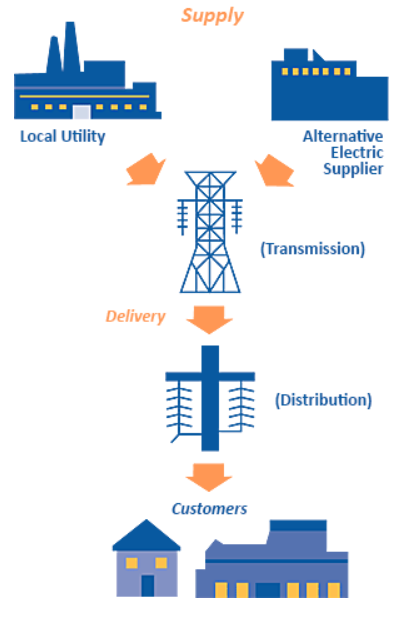
The Electric Customer Choice program offers the ability to choose the electric supply portion of your energy use. The delivery portion of your energy service remains separate.
A supplier is the company that generates electricity for you or buys electricity for your use from another generator. A supplier other than your local utility is called an “Alternative Electric Supplier” or AES. Under this program you can choose to buy your electric supply from an AES, if one is available to you. You are not obligated to choose a different electric supplier. UPPCO will remain your electric supplier unless you choose otherwise.
The delivery of energy will remain as a service from UPPCO and will continue to be regulated by the Michigan Public Service Commission. Delivery services include responding to emergencies, maintaining power lines and customer service support.
Alternative Electric Suppliers
There are two key reasons why customers won’t find many other alternative energy supply options. One is due to the Upper Peninsula’s limited market size. A new supplier would have to build a small generating plant to serve the area, and a small plant would have a hard time competing with larger plants that typically cost less to operate. Second, the transmission lines that deliver electricity to the U.P. are already at capacity. A new
Learn More ExpandThere are two key reasons why customers won’t find many other alternative energy supply options. One is due to the Upper Peninsula’s limited market size. A new supplier would have to build a small generating plant to serve the area, and a small plant would have a hard time competing with larger plants that typically cost less to operate. Second, the transmission lines that deliver electricity to the U.P. are, already at capacity. A new supplier may not have the ability to put additional electricity through the lines to serve more customers.
Alternative electric suppliers must register and be licensed by the state of Michigan and be certified by UPPCO before serving customers. A list of Alternative Electric Suppliers licensed by the state can be found on the Michigan Public Service Commission’s web site at www.michigan.gov/mpsc.
Customers that find an Alternative Electric Supplier to serve them must enter into contracts. Guidelines for switching to an Alternative Electric Supplier include:
- A customer must satisfy any past due balance with the utility prior to taking service from an AES under the RAST tariff.
- There is a charge to switch suppliers more than once a year.
- Only one switch request can be issued at a time.
- Customers on special rate schedules may need to make special arrangements.
- Requests for historical energy use information can be made once a year at no cost to the customer.
- An AES or the customer can make a request for usage information. (AES must have written authorization from customer before company will provide an AES with customer usage information)
- Interval meter equipment may need to be installed at the customer’s expense.
- A “switch request form” must be submitted by the AES and validated by UPPCO.
www.michigan.gov/mpsc.
Changes to Your Energy Bill
Customers will see separate charges for both supply and delivery on their bill. This is in an effort to help you better understand your energy costs.
The charges associated with energy delivery (distribution) are:
Learn More ExpandCustomers will see separate charges for both supply and delivery on their bill. This is in an effort to help you understand your energy costs better.
The charges associated with energy delivery (distribution) are:
- Energy Charge – The energy charge varies with the amount of electricity you use. Electricity is measured in kilowatt-hours (kWh). You are charged the delivery of electricity for each kWh of electricity you use.
- Customer Charge – This is a fixed charge. It covers costs to operate and maintain electric facilities and provide customer service support.
The charges associated with energy (power) are:
- Energy Charge – Again, this charge varies with the amount of electricity you use. This amount is for the actual electric supply.
- Power Cost Adjustment – This charge accounts for any difference in costs of producing or purchasing electricity to meet your needs. It appears as a credit or charge on your bill, based on how actual costs compare to the Energy Charge.
In the future, if you choose an Alternative Electric Supplier as part of the Electric Customer Choice program, the electric supply portion of your bill may change, but the local delivery service charges will not.
If you choose to buy your electric supply from an Alternative Electric Supplier, you may receive two bills-one from the AES for energy supply and one from UPPCO for delivery service. If offered, one complete bill may be provided by UPPCO, which includes AES charges.
Average Fuel Mix Comparisons
As a Michigan resident, you have the option to choose the company that provides your electric supply. This stems frrom the Customer Choice and Electricity Reliability Act that took effect January 1, 2002. When choosing a supplier, you should know the sources of generation different companies may have. Included here is information about the UPPCO fuel mix and emissions, compared to other regions.
Learn More ExpandAs a Michigan resident, you have the option to choose the company that provides your electric supply. This stems frrom the Customer Choice and Electricity Reliability Act that took effect January 1, 2002. When choosing a supplier, you should know the sources of generation different companies may have. Included here is information about the UPPCO fuel mix and emissions, compared to other regions.
Percentage of Fuel Type Used to Produce Electricity: UPPCO vs. Regional Average*
The information shown in the tables includes data for different time periods, due to the availability of such data. In making energy purchase decisions, you may find it more helpful to compare the fuel mix data of individual suppliers to that of other individual suppliers, rather than comparing the fuel mix of any one supplier to the regional fuel mix.
Percentage of Fuel Type Used to Produce Electricity| Fuel type | Company Owned | Purchased | Regional Average* |
|---|---|---|---|
| Coal | 0% | 22% | 26% |
| Nuclear | 0% | 20% | 24% |
| Natural Gas | 0% | 30% | 36% |
| Oil | less than 1% | less than 1% | less than 1% |
| Hydroelectric | 15% | less than 1% | less than 1% |
| Renewable Fuels | 0% | 11% | 13% |
| Biofuel | 0% | less than 1% | less than 1% |
| Biomass | 0% | less than 1% | less than 1% |
| Solar | 0% | 3% | 3% |
| Solid Waste Incineration** | 0% | less than 1% | less than 1% |
| Wind | 0% | 7% | 8% |
| Wood | 0% | less than 1% | less than 1% |
** Includes landfill gas
The information shown is for the UPPCO system, which includes generation in Michigan. It is for the period of April 2017 through March 2018. The regional information is for the 12-month period of August 2016 through July 2017.
Solid Waste Incineration includes landfill gas.
The fuel mix data for the electricity supplied to you by UPPCO includes regional average fuel mix data from Michigan, Illinois, Indiana, Ohio and Wisconsin as a proxy for the actual fuel mix of certain electricity purchased by UPPCO. This is because the actual fuel mix of that purchased electricity could not be discerned. Purchased electricity accounted for 83.20% of the electricity supplied by UPPCO during the relevant period.
Airborne Emissions and High-Level Nuclear Waste Comparison: UPPCO vs. Regional Average*
As a Michigan resident, you have the option to choose the company that provides your electric supply. This stems frrom the Customer Choice and Electricity Reliability Act that took effect January 1, 2002. When choosing a supplier, you should know the sources of generation different companies may have. Included here is information about the UPPCO fuel mix and emissions, compared to other regions.
Percentage of Fuel Type Used to Produce Electricity: UPPCO vs. Regional Average*
The information shown in the tables includes data for different time periods, due to the availability of such data. In making energy purchase decisions, you may find it more helpful to compare the fuel mix data of individual suppliers to that of other individual suppliers, rather than comparing the fuel mix of any one supplier to the regional fuel mix.
Percentage of Fuel Type Used to Produce ElectricityUPPCO vs Regional Average
| Type of Emission/Waste | UPPCO Average ( lb / MWh ) | Regional Average* ( lb / MWh ) |
|---|---|---|
| Sulfer Dioxide | 1.02 | 1.25 |
| Carbon Dioxide* | 1,023 | 1,248 |
| Oxides of Nitrogen | 0.75 | 0.91 |
| High-level Nuclear Waste | .0049 | 0.006 |
* Regional Average: Michigan, Illinois, Indiana, Ohio and Wisconsin
The regional information for sulfur dioxide, carbon dioxide and nitrogen oxides is for the 12-month period of January – December 2015. The UPPCO information is for the 12-month period of April 2016 through March 2018.
Carbon Dioxide emissions for the historical years 1998-2008 have been revised by EIA due to changes in emission factors.
High-Level Nuclear Waste is based on discharged fuel for a time frame span approximately two years in length, ending in 2002.
CAP Tracking System
Michigan Electric Choice participation is limited to 10% of UPPCO’s weather adjusted sales for the previous calendar year. Shown below is the load available to be served by an Alternative Electric Supplier (AES) and current participation levels.
Learn More ExpandMichigan Electric Choice participation is limited to 10% of UPPCO’s weather adjusted sales for the previous calendar year. Shown below is the load available to be served by an Alternative Electric Supplier (AES) and current participation levels.
Load Available to be Served by an AESand Current Participation Levels
| Current as of June 4, 2026 | |
|---|---|
| 2025 Retail Sales (MWh) | 708,027 |
| 2025 Weather Adjusted Retail Sales (MWh) | 706,255 |
| 2026 AES Cap (MWh) | 78,954 |
| Current Level of Choice Participation (MWh) | 83,281 |
| Total Energy Allotment Awarded (Not Yet Served by AES) | - |
| 2026 Energy Allotment Available (MWh) | - |
| Customers in Queue | 29 |
| Total Energy in Queue (MWh) | 23,112 |
* Energy allotment available may not equal zero if the first customer in queue on the waiting list has annual energy usage exceeding the energy allotment available.
For more information call UPPCO at (906) 449-2014 or visit theMichigan Public Service Commission website. This is the anchor location for Outdoor Lighting. Do Not Delete!

Outdoor Lighting
NOTICE: Effective February 1, 2019, all customers with lights eligible/included in the LED upgrade project had the per fixture charge for their outdoor lighting changed to the approved LED rate on their monthly statement. UPPCO is accelerating our normal 5-Year outdoor lighting maintenance schedule to upgrade all outdoor LED lights within two to three years. In addition, the kilowatt-hour savings of the LED fixtures is being passed on to customers immediately, regardless of when the light fixture is changed.
If you would like outdoor lighting for your business, we’ll recommend a lighting system to suit your needs and handle all installation and wiring. Creating an outdoor lighting system that’s efficient, well-planned and suited to your situation is easy with help from UPPCO.
*For commercial applications Cobra Area Lighting is recommended/all that is available.
LED lighting is currently the most energy efficient. As such, all UPPCO outdoor lighting options are now LED.
*UPPCO will not install a light fixture onto to a customer-owned structure or pole. If you would like the outdoor lighting option, UPPCO must install the pole and fixture.
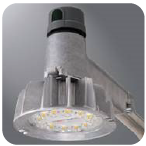
Dusk-to-Dawn Security Light
The Dusk-to-Dawn security light has a 360-degree light pattern that provides security at low cost. It’s an ideal option for rural homes on large lots.| Details | Equivalent Wattages Available |
|---|---|
| 100 watt | |
| 150 watt | |
| 400 watt |
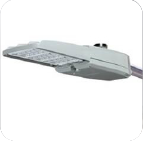
Shoebox Light
If you need overhead lighting for a parking lot or small park, shoebox lights are often just what you need. These fixtures mount on top of poles to provide light from above.| Details | Equivalent Wattages Available |
|---|---|
| 150 watt | |
| 250 watt | |
| 400 watt | |
| 400 watt |
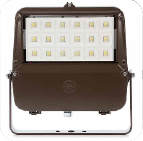
Powerflood Floodlight
The Powerflood floodlight projects a high concentration of light to a focused area, making it ideal for grounds and parking lots. Floodlights can be configured in a variety of ways to meet specific coverage needs, such as on building facades and in barn and loading areas. Some floodlights can have a beam spread of up to 120 degrees. It can illuminate a larger amount of space with the same wattage and lumen output as a spotlight.| Details | Equivalent Wattages Available |
|---|---|
| 250 watt | |
| 400 watt | |
| 1000 watt | 400 watt |
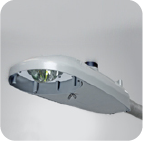
Cobra Area Light
The Cobra area light fixture provides an oval-shaped light pattern that’s ideal for improving the safety and security of long, rural driveways and barnyards. It is designed to focus light on the area you choose, while minimizing light that could affect a neighbor.| Details | Equivalent Wattages Available |
|---|---|
| 100 watt | |
| 150 watt | |
| 250 watt | |
| 400 watt | |
| 400 watt |
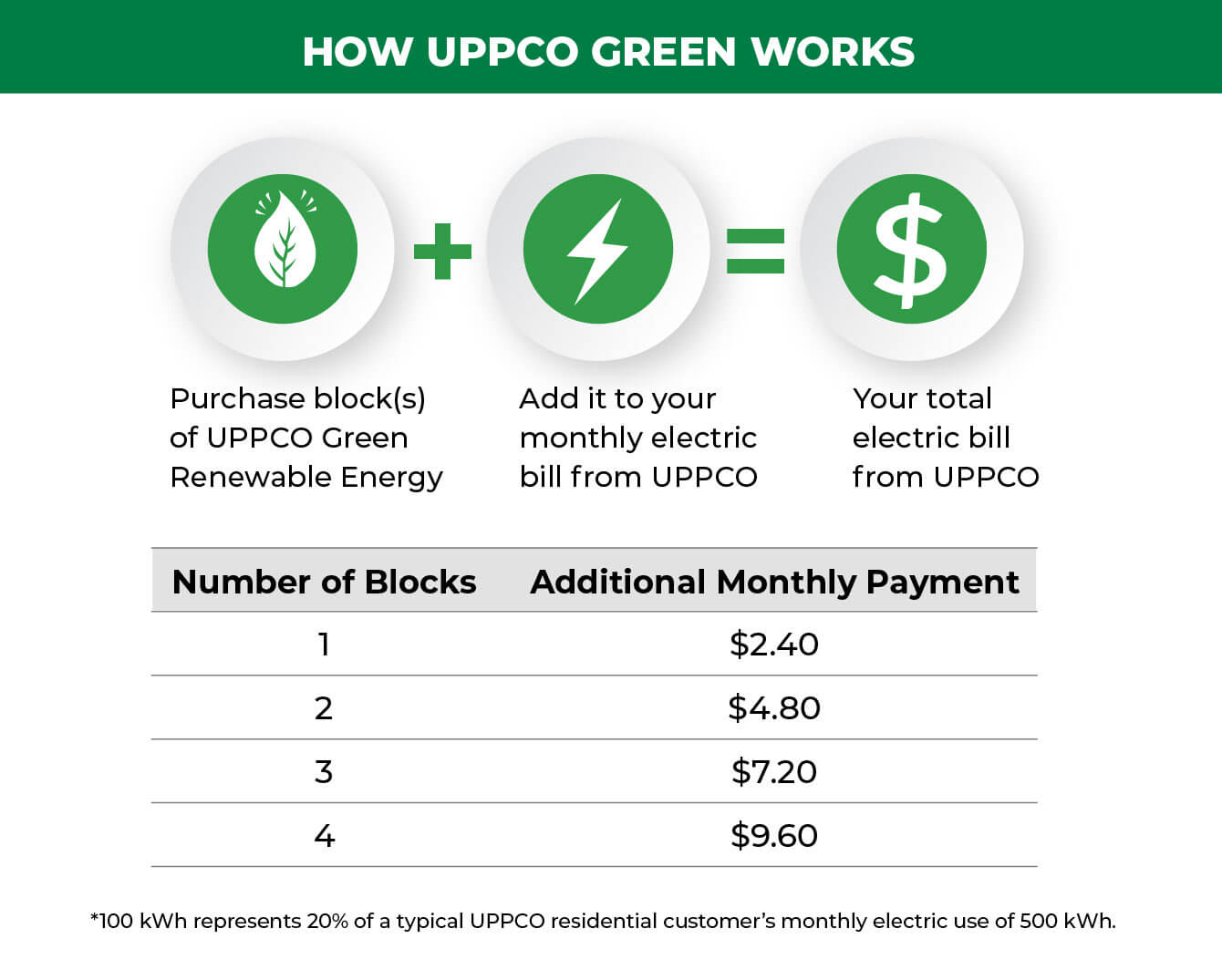
UPPCO Green
UPPCO Green ensures the energy you use comes from UPPCO hydroelectric renewable generation.
When you join UPPCO Green, you’re making a bold commitment to environmental stewardship. That’s because the energy you purchase through UPPCO Green comes from clean, safe, locally produced hydroelectric facilities. It’s an affordable way to invest in a sustainable future, with no need to make significant changes or purchase equipment.
Click here to learn more about our hydroelectric capabilities and benefits to the community.
Joining UPPCO Green helps to:
- Reduce reliance on fossil fuels
- Cut down on greenhouse gas emissions
- Preserve resources for future generations
- Earn LEED certification points
- Support continued production and expansion of local renewable energy resources
 CONTACT
To Learn More about
UPPCO GREEN
UPPCO Customer Service
(906) 449-2013
customerservice@uppco.com
 This is the anchor location for Customer Handbook. Do Not Delete!