
Approved by Michigan Public Service Commission
UPPCO’s rates are certified and approved by the Michigan Public Service Commission. To view the most current schedule of rates and MPSC regulations governing the sale of electricity by UPPCO, visit the MPSC website. Power costs are explained in the Power Distribution Comparison illustration (PNG) that demonstrates why electricity can cost more in our Upper Peninsula service area.
Section A
Title Page (PDF)
Index (PDF)
Table of Contents (PDF)
Electric Service or Franchise Area (PDF)
List of Communities Served (PDF)
Technical Terms and Abbreviations (PDF)
Section B
Administrative Rules Index (PDF)
Section C
Standard Rules and Regulations – Introductions (PDF)
Standard Rules and Regulations – Terms and Conditions of Service (PDF)
Standard Rules and Regulations – Line Extension Construction Policy (PDF)
Standard Rules and Regulations – Emergency Electrical Procedures (PDF)
Standard Rules and Regulations – Definitions, Technical Terms, and Abbreviations (PDF)
Standard Rules and Regulations – Customer Data Privacy (PDF)
Section D
A-1: Residential Service – Urban and Rural (PDF)
AH-1: Residential Heating Service – Urban and Rural (PDF)
C-1: General Service – Urban and Rural (PDF)
H-1: Commercial Heating Service – Urban and Rural (PDF)
P-1: Light and Power Service – Urban and Rural (PDF)
CP-U: Large C&I – CP (PDF)
WP-3: Light and Power Service (PDF)
CP-I: Commercial Power – Interruptible Rider (PDF)
CP-IB: Capacity Buyback Rider (PDF)
CP-RR: Large Light and Power Response Rewards (PDF)
RTMP: Real-Time Market Pricing (PDF)
RTMP-D: Real Time Market Pricing – Distribution Service (PDF)
SL-3: Street Lighting Service (PDF)
SL-5: Street Lighting Service (PDF)
SL-6: Street Lighting Service (PDF)
Z-3: Dusk to Dawn Outdoor Security Lighting (PDF)
SL-X: Street Lighting Rules (PDF)
PSDS: Power Supply Default Service – Integrated (PDF)
PSDS: PSDS Power Supply Default Service – Iron River (PDF)
CAB: TV Pole Contact Rental Rates – Integrated (PDF)
CAB: CAB TV Pole Contact Rental Rates – Iron River (PDF)
UPPCO Green (PDF)
PG-NM: Parallel Generation – Net Metering Program (PDF)
PG-2: Parallel Generation – Modified Net Metering Program (PDF)
PG-3: Parallel Generation – Methane Digesters (PDF)
PG-4: Parallel Generation – Purchase by UPPCO (PDF)
EWR: Energy Waste Reduction (PDF)
PSCR: Power Supply Cost Recovery (PDF)
Decoupling (PDF)
LIEAF: LIEAF Low-Income Energy Assistance Fund (PDF)
DG: Distributed Generation Rider (PDF)
Section E
RAST: Retail Access Service Tariff (PDF)
Section F
Electric Customer Choice
Since January 2002, all electric customers in the state of Michigan have the option of choosing the company that provides their electric supply. As a customer of UPPCO, we want you to know what these energy choices may mean to you.
Background Information
On June 3, 2000, Michigan Governor John Engler signed into law the Customer Choice and Electric Reliability Act (Act 141). Since then, legislators, consumers and energy suppliers have worked together to put into place program details and protective guidelines that will help customers benefit from these new energy choices.
Public Act 286 of 2008 (Act 286) was enacted on October 6, 2008 and amended PA 141. Section 10a(1)(a) of Act 286 requires limiting the amount of electricity that can be obtained from AESs to “no more than 10% of an electric utility’s average weather adjusted retail sales for the preceding calendar year.” As a result, the Commission issued an order on October 21, 2008 in Case No. U-15801 to establish rules for allocating the sales as specified in Section 10a (1)(b)-(d). In its order dated September 29, 2009 in Case No. U-15801, the Commission outlined the specific procedures pertaining to the 10 percent cap, and also established the details of the each utilities’ electric choice Cap Tracking System.
Customer choice has been implemented in many other states at varying levels. You may have heard it called customer retail access or the restructuring or deregulation of the utility industry. In Michigan, the program is called Electric Customer Choice.
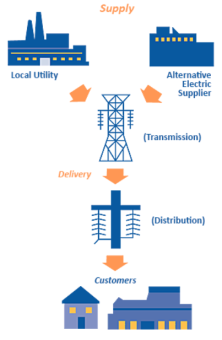 The Electric Customer Choice program offers the ability to choose the electric supply portion of your energy use. The delivery portion of your energy service remains separate.
A supplier is the company that generates electricity for you or buys electricity for your use from another generator. A supplier other than your local utility is called an “Alternative Electric Supplier” or AES. Under this program you can choose to buy your electric supply from an AES, if one is available to you. You are not obligated to choose a different electric supplier. UPPCO will remain your electric supplier unless you choose otherwise.
The delivery of energy will remain as a service from UPPCO and will continue to be regulated by the Michigan Public Service Commission. Delivery services include responding to emergencies, maintaining power lines and customer service support.
There are two key reasons why customers won’t find many other alternative energy supply options. One is due to the Upper Peninsula’s limited market size. A new supplier would have to build a small generating plant to serve the area, and a small plant would have a hard time competing with larger plants that typically cost less to operate. Second, the transmission lines that deliver electricity to the U.P. are already at capacity.
Alternative Electric Suppliers
There are two key reasons why customers won’t find many other alternative energy supply options. One is due to the Upper Peninsula’s limited market size. A new supplier would have to build a small generating plant to serve the area, and a small plant would have a hard time competing with larger plants that typically cost less to operate. Second, the transmission lines that deliver electricity to the U.P. are, already at capacity. A new supplier may not have the ability to put additional electricity through the lines to serve more customers.
Alternative electric suppliers must register and be licensed by the state of Michigan and be certified by UPPCO before serving customers. A list of Alternative Electric Suppliers licensed by the state can be found on the Michigan Public Service Commission’s web site at www.michigan.gov/mpsc.
Customers that find an Alternative Electric Supplier to serve them must enter into contracts. Guidelines for switching to an Alternative Electric Supplier include:
- A customer must satisfy any past due balance with the utility prior to taking service from an AES under the RAST tariff.
- There is a charge to switch suppliers more than once a year.
- Only one switch request can be issued at a time.
- Customers on special rate schedules may need to make special arrangements.
- Requests for historical energy use information can be made once a year at no cost to the customer.
- An AES or the customer can make a request for usage information. (AES must have written authorization from customer before company will provide an AES with customer usage information)
- Interval meter equipment may need to be installed at the customer’s expense.
- A “switch request form” must be submitted by the AES and validated by UPPCO.
A list of Alternative Electric Suppliers licensed by the state can be found on the Michigan Public Service Commission website at www.michigan.gov/mpsc.
Changes to Your Energy Bill
Customers will see separate charges for both supply and delivery on their bill. This is in an effort to help you better understand your energy costs.
The charges associated with energy delivery (distribution) are:
- Energy Charge – The energy charge varies with the amount of electricity you use. Electricity is measured in kilowatt-hours (kWh). You are charged the delivery of electricity for each kWh of electricity you use.
- Customer Charge – This is a fixed charge. It covers costs to operate and maintain electric facilities and provide customer service support.
The charges associated with energy (power) are:
- Energy Charge – Again, this charge varies with the amount of electricity you use. This amount is for the actual electric supply.
- Power Cost Adjustment – This charge accounts for any difference in costs of producing or purchasing electricity to meet your needs. It appears as a credit or charge on your bill, based on how actual costs compare to the Energy Charge.
In the future, if you choose an Alternative Electric Supplier as part of the Electric Customer Choice program, the electric supply portion of your bill may change, but the local delivery service charges will not.
If you choose to buy your electric supply from an Alternative Electric Supplier, you may receive two bills-one from the AES for energy supply and one from UPPCO for delivery service. If offered, one complete bill may be provided by UPPCO, which includes AES charges.
Average Fuel Mix Comparisons
As a Michigan resident, you have the option to choose the company that provides your electric supply. This stems frrom the Customer Choice and Electricity Reliability Act that took effect January 1, 2002. When choosing a supplier, you should know the sources of generation different companies may have. Included here is information about the UPPCO fuel mix and emissions, compared to other regions.
Percentage of Fuel Type Used to Produce Electricity: UPPCO vs. Regional Average*
The information shown in the tables includes data for different time periods, due to the availability of such data. In making energy purchase decisions, you may find it more helpful to compare the fuel mix data of individual suppliers to that of other individual suppliers, rather than comparing the fuel mix of any one supplier to the regional fuel mix.
Percentage of Fuel Type Used to Produce Electricity
| Fuel type | Company Owned | Purchased | Regional Average* |
|---|---|---|---|
| Coal | 0% | 22% | 26% |
| Nuclear | 0% | 20% | 24% |
| Natural Gas | 0% | 30% | 36% |
| Oil | less than 1% | less than 1% | less than 1% |
| Hydroelectric | 15% | less than 1% | less than 1% |
| Renewable Fuels | 0% | 11% | 13% |
| Biofuel | 0% | less than 1% | less than 1% |
| Biomass | 0% | less than 1% | less than 1% |
| Solar | 0% | 3% | 3% |
| Solid Waste Incineration** | 0% | less than 1% | less than 1% |
| Wind | 0% | 7% | 8% |
| Wood | 0% | less than 1% | less than 1% |
*Regional Average: Michigan, Illinois, Indiana, Ohio, and Wisconsin
** Includes landfill gas
The information shown is for the UPPCO system, which includes generation in Michigan. It is for the period of April 2019 – March 2020. The regional information is for the 12-month period of August 2018 through July 2019.
The fuel mix data for the electricity supplied to you by UPPCO includes regional average fuel mix data from Michigan, Illinois, Indiana, Ohio and Wisconsin as a proxy for the actual fuel mix of certain electricity purchased by UPPCO. This is because the actual fuel mix of that purchased electricity could not be discerned. Purchased electricity accounted for 83.20% of the electricity supplied by UPPCO during the relevant period.
Airborne Emissions and High-Level Nuclear Waste Comparison: UPPCO vs. Regional Average*
As a Michigan resident, you have the option to choose the company that provides your electric supply. This stems frrom the Customer Choice and Electricity Reliability Act that took effect January 1, 2002. When choosing a supplier, you should know the sources of generation different companies may have. Included here is information about the UPPCO fuel mix and emissions, compared to other regions.
Percentage of Fuel Type Used to Produce Electricity: UPPCO vs. Regional Average*
The information shown in the tables includes data for different time periods, due to the availability of such data. In making energy purchase decisions, you may find it more helpful to compare the fuel mix data of individual suppliers to that of other individual suppliers, rather than comparing the fuel mix of any one supplier to the regional fuel mix.
Percentage of Emission / Waste by Type (UPPCO vs Regional Average)
| Type of Emission/Waste | UPPCO Average (lb / MWh) | Regional Average* (lb / MWh) |
|---|---|---|
| Sulfer Dioxide | 1.02 | 1.25 |
| Carbon Dioxide | 1,023 | 1248 |
| Oxides of Nitrogen | 0.75 | .091 |
| High-level Nuclear Waste | .0049 | .006 |
*Regional Average: Michigan, Illinois, Indiana, Ohio, and Wisconsin
The regional information for sulfur dioxide, carbon dioxide and nitrogen oxides is for the 12-month period of January – December 2018. The UPPCO information is for the 12-month period of January through December 2019.
Carbon Dioxide emissions for the historical years 1998-2008 have been revised by EIA due to changes in emission factors.
High-Level Nuclear Waste is based on discharged fuel for a time frame span approximately two years in length, ending in 2002.
CAP Tracking System
Michigan Electric Choice participation is limited to 10% of UPPCO’s weather adjusted sales for the previous calendar year. Shown below is the load available to be served by an Alternative Electric Supplier (AES) and current participation levels.
Load Available to be Served by an AES and Current Participation Levels
| Current as of November 12, 2025 | |
|---|---|
| 2025 Retail Sales (MWh) | 708,027 |
| 2025 Weather Adjusted Retail Sales (MWh) | 706,255 |
| 2026 AES Cap (MWh) | 78,954 |
| Current Level of Choice Participation (MWh) | 83,281 |
| Total Energy Allotment Awarded (Not Yet Served by AES) | - |
| 2026 Energy Allotment Available (MWh) | - |
| Customers in Queue | 29 |
| Total Energy in Queue (MWh) | 23,112 |
For more information call UPPCO at (906) 449-2013 or visit the Michigan Public Service Commission website.